
There is only one point in time, and everything is always there.
The basis for this is physics, but it impacts philosophy, religion, and everyday life, including our understanding of free will.
Physics
In science, we often draw a graph of how something changes with time. Very useful mathematically and to quickly see what’s going on.
In fundamental physics, when you plot something’s position in space as a function of time, the time axis is taken literally as a dimension, like the three space axes but perpendicular to them. Altogether these four perpendicular dimensions are called spacetime. In drawings to illustrate this, for simplicity we just show one space dimension.
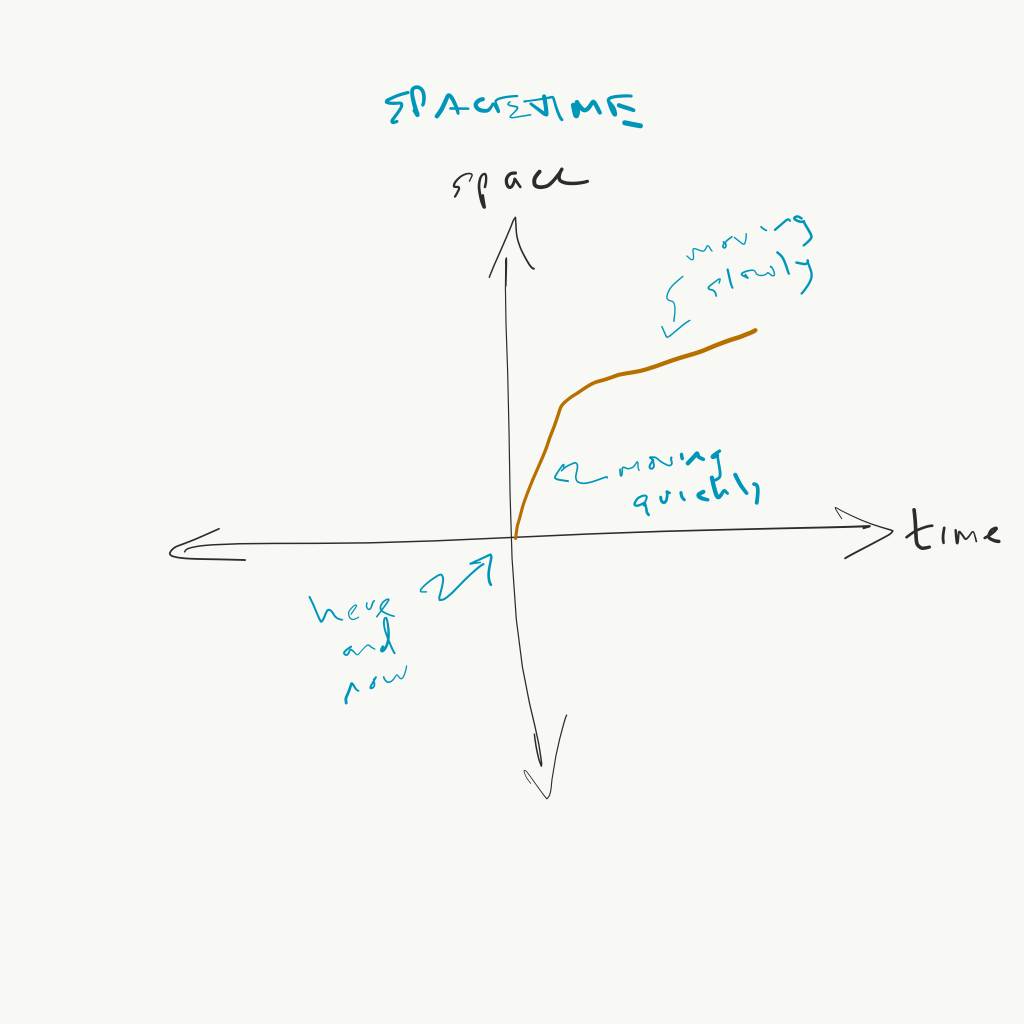
Spacetime originated with relativity and has been adopted by quantum mechanics, quantum field theory, string theory, and nearly all branches of fundamental physics. Read more about how spacetime became a thing.
But I think it’s incorrect to treat time as a physical dimension. It’s useful mathematically and visually. But if you were to draw the physical time axis, I believe it would just be a single point. Why do I think that? It originated with my physics research – details in progress.
There is a branch of fundamental physics called loop quantum gravity in which there is no time dimension (or space dimensions either). Loop quantum gravity is one developing theory trying to merge relativity and quantum mechanics.
Otherwise, treating time as a physical dimension is nearly universal in physics. But it matters beyond just physics…
Philosophy / Religion / Everyday Life
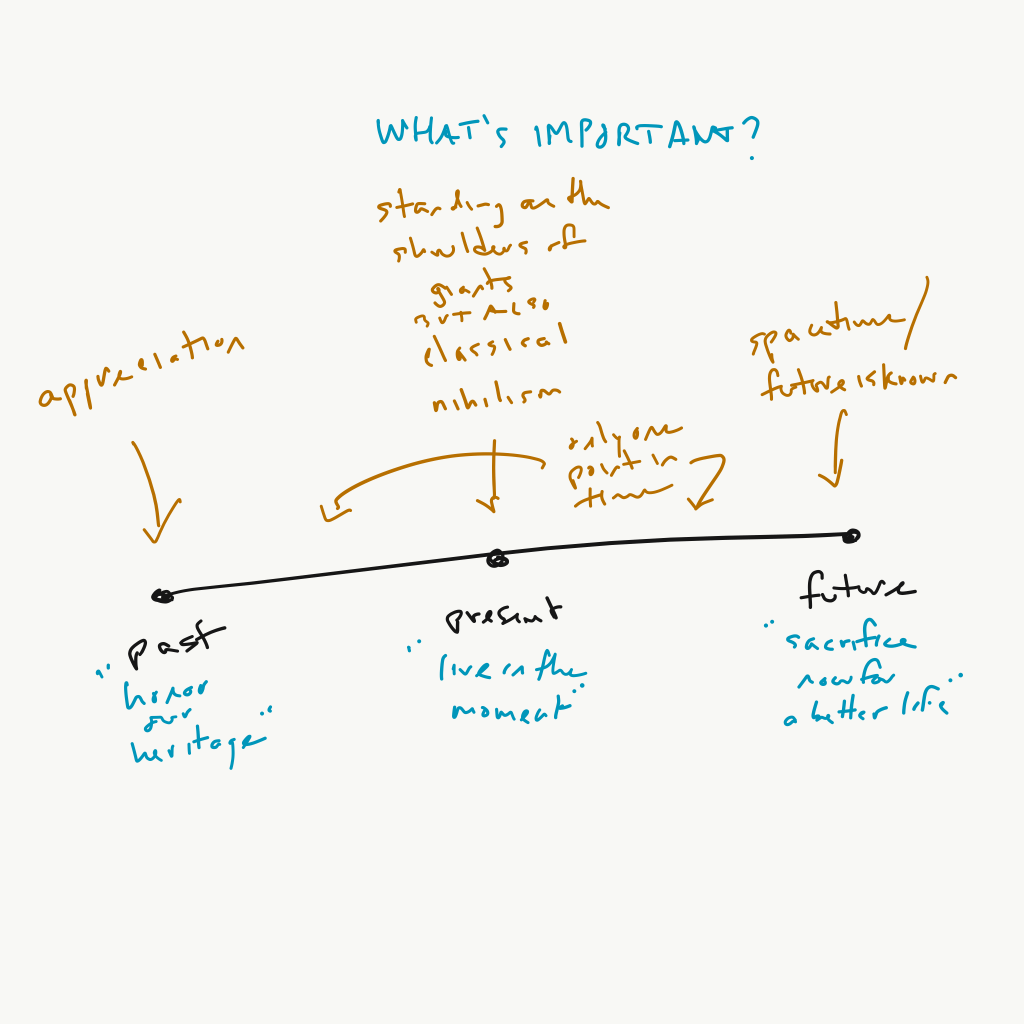
In the first half of the 20th century, the concept of spacetime expanded from physics to become part of common culture. We easily imagine a future already out there, just waiting for us to arrive, and able to be known before we actually get there. We can plot it on a graph, and we’re told by science that time is a physical dimension, and everything can be laid out in front of us on a long axis. It’s spacetime! We can look across a distance and see things there. We can’t look across time like that, but spacetime tells us it’s basically the same concept.
In this common view, even if we don’t know exactly what the future looks like, or the past either, the dimension is there and it’s real and everything is laid out there.
This perspective isn’t universal outside of physics – there are whole branches of thought that emphasize the importance of the present moment and deemphasize the importance of the past and future. This view is well-represented by The Power of Now >. That’s not what this is, and I’ll get it that below.
So what branches of thought do subscribe to the Time is a Physical Dimension aka The Future is Out There viewpoint?
Philosophy
In the theory of knowledge, one perspective is that if we’re smart enough we can figure out the future. That the universe knows the future, and, in principle, we can too. This desire is common among humans, and the viewpoint is we just need to be smarter, try harder, find better better equations or means of analysis, make more powerful computers.
This belief and our strivings do indeed improve our knowledge of the future! So it’s kind of a self-fulfilling prophecy. If you don’t think the future is knowable, then you certainly won’t know a bit about the future. If you think the future is knowable, you will find out some things about the future. This is similar to free will.
So the question remains whether the future is out there, and able to be perfectly known before it happens. Does God know the future? Does the universe know the future? Let’s leave philosophy and turn to religions and everyday life.
Religions
In the Western religions – Judaism, Christianity, Islam – there’s one creator god who is all-knowing – Yahweh, God, Allah. The creator god knows everything about the present, the past, and the future. We humans are imperfect, which means we fall short of the creator god’s characteristics, so we don’t know everything. Yet everything about the future is known! Yahweh / God / Allah knows the future.
This view of an omniscient being fits perfectly with spacetime. We humans don’t know the future super well, but someone knows it.
So both science (fundamental physics) and religions (Western style) tell us the future out there and known by Yahweh / God / Allah and the universe. That’s a powerful combination in support of this idea.
Everyday Life
In everyday life, the belief that the future is knowable is common and useful. People try to predict the stock market and many other things, like their lives, with certainty. Everyone knows you can’t be 100% certain, but the feeling is still that the answer is out there and you can discover it.
The fact is the future not only hasn’t happened yet, but the future is unknown even to the universe! The universe is working as fast as it can to figure out the future, and that’s what we experience as time moving forward. Read about how the universe does this.
What Does It Mean for Us?
Does this mean you can’t know anything about the future, that the present doesn’t affect the future, that you shouldn’t try to achieve the future you want?
Does it mean you should live only in the present, the way live-in-the-present advocates advocate?
Definitively not – those are also incorrect. What happens in the present definitely affects the future. Trying to act in the present to improve our futures does indeed increase our chances for better outcomes. Read more about how this works in the paradox of sports and free will.
So what does it mean? It means we should accept that reality is somewhere between these two extremes. The present is all there is, true, but the past got us here and the present affects what comes next. So we should live in these two in-between zones.
NEXT IN THIS SERIES: Free will: the definition
 Very Universe